Subterranean termites require direct soil contact to maintain moisture levels, traveling into framing lumber through mud shelter tubes built over exposed concrete foundations. Across Dallas County, properties built on…
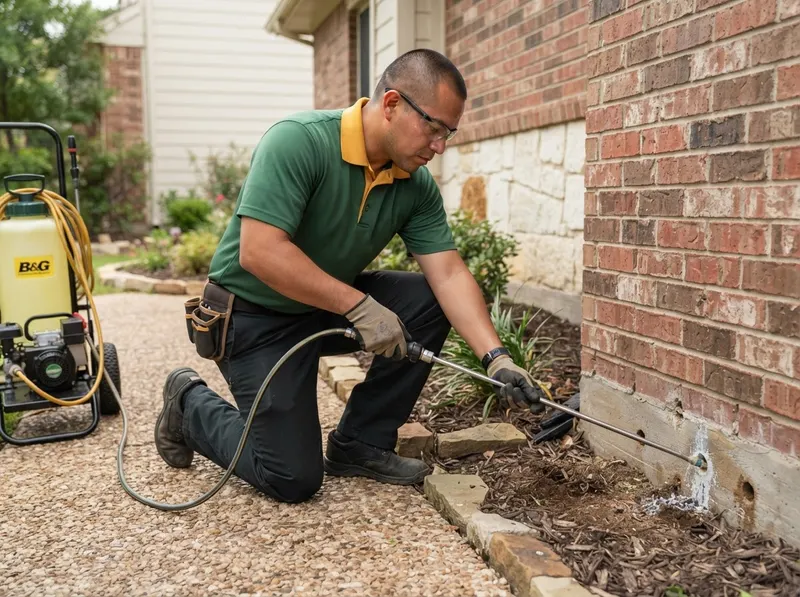
Subterranean termites require direct soil contact to maintain moisture levels, traveling into framing lumber through mud shelter tubes built over exposed concrete foundations. Across Dallas County, properties built on Blackland Prairie clay soils experience continuous soil shifting, expanding during wet spring months and pulling away from foundation edges during dry summers. These cyclical soil fractures create direct subterranean access channels through expansion joints, plumbing penetrations, and exterior weep holes in neighborhoods like Lake Highlands, Northwood Hills, and Lakewood. In older pier-and-beam homes common throughout Oak Cliff, Kessler Park, and Lower Greenville, subterranean colonies often enter via crawlspace support piers beneath kitchen and bathroom subflooring.
Effective defense relies on creating an unbroken protective perimeter using non-repellent liquid termiticides, such as fipronil, or installing calibrated bait monitoring stations every 10 to 15 feet around the drip line. Liquid barrier treatments require digging a 6-inch by 6-inch trench directly against the exterior foundation grade, applying 4 gallons of finished emulsion per 10 linear feet, and backfilling the treated soil. Where flatwork abuts structural walls, such as covered patios, carports, and wrap-around driveways in Preston Hollow and Uptown, concrete is core-drilled at 12-inch intervals to inject termiticide directly into the underlying aggregate before being patched with hydraulic cement.
Property owners evaluating subterranean termite defense navigate an operational trade-off between immediate liquid barriers and exterior baiting systems. Liquid treatments bond directly to soil particles to establish a protective barrier that eliminates foragers on contact within 30 to 90 days, though extensive hardscaping requires visible concrete patching. In-ground baiting stations avoid slab drilling and continuously monitor colony presence using cellulose matrices treated with chitin synthesis inhibitors, but require 90 to 180 days to achieve complete colony elimination. Spot treatments address localized swarms inside living areas but leave unprotected foundation sections vulnerable; full-perimeter treatments protect the entire footprint without requiring ongoing 12-month service commitments.
Every job gets a firm, written price after a free on-site visit.
Tell us about your subterranean termite treatment job in Dallas and we'll send a clear, written quote, usually the same day.
 Green Tractor Pest Control